
As doulas we recognise that good communication is really important both between us and the families we serve and between the families and any medical professionals they choose to care for them.
Doulas have always tried to facilitate good communication with medical care staff. We’ve often experienced that this can be easier with some healthcare professionals than others. One reason this can sometimes be more challenging is when health professionals don’t have a full understanding of what doulas are and do.
These are just a few thoughts, tips and ideas that may help you understand how doula support is different from and complimentary to healthcare support. We hope this will help facilitate good communication and understanding between doulas, families and medical care staff.
Doulas Support
If you ask anyone who has even heard of a doula what doulas do, you will almost certainly hear the word support somewhere in their answer. But what support means might be open to interpretation.
What is “support” according to the dictionary?
Support – to help or encourage somebody/something by saying or showing that you agree with them/it.
That’s pretty clear then, doulas agree with you -our clients, encourage you and help you. Our support is as simple as always thinking you’re amazing and trusting you to make decisions about your own body and baby.
It’s important to know that the kind of support doulas offer is a type of peer support. It’s emotional and practical support such as might be given to you by a good friend or family member. A doula being a paid professional doesn’t change this. We need to be clear that although society is now split much more often into nuclear families than extended ones the traditional support the wider family and village would have provided hasn’t stopped being needed. It’s just that now it’s often found in different ways, sometimes between friends, by charities, in support groups but also very often with paid support. This includes paid directly or paid by a charity, health service, local government etc. The support remains the same, emotional and practical, and compliments rather than fights the medical support and advice that doctors and midwives offer.
Medical Support
Many midwives (and some doctors) also consider that emotional support is part of their job description and some may feel sad that they often don’t have enough time to really focus on that as much as they would like, due to the pressure of working in a system that allocates time limits on appointments etc. It’s possible, if they feel this is replacing them in some way, they can feel a little sad or put out that parents may choose to also have support from a doula. We would love to reassure those health professionals that we have no intention of replacing their support as medical professionals. Practical and emotional support from a Doula is very valuable in it’s own unique way it is not the same as providing medical care and advice in a supportive way. We really appreciate when our clients also receive medical care that is wrapped in an emotionally sensitive and respectful person centred approach.
Your doula may have knowledge or be able to sign post you to evidence based places to find the information you’re looking for on many different topics. We know good books, websites and podcasts for example. But your doula isn’t a subject matter or medical “expert” they don’t have any kind of higher authority than you do, they are not there for advice. When we say we don’t provide advice we’re not just talking about medical advice we’re talking about having any kind of idea that one decision you could take is better than another unless you feel it is for yourself.
Support for choices
If we say we support a certain type of birth or experience for families we’re saying we support there being that option available for families who want to choose it. If a doula supports home birth that doesn’t mean thinking home birth is right for everyone whether it’s what they want to or not. It means the availability of home birth as a choice some families may make if they feel it’s right for them in the light of all the information and individual medical advice they have been given. If we say we support elective cesarean birth that doesn’t mean we think everyone should choose a c-section. It means if you want to choose a cesarean birth with all the information and individual medical advice you’ve been given we believe that choice should be there for you.
Support for how you feel right now
Doulas also support you and your choices in the moment. We don’t get stuck on what you said at one point when you had less information or experience than you have now. Your doula may support you with making a “birth plan” or “preferences document” to help you communicate with your medical care team. But doulas also support you being flexible and having the right to change your mind and decisions if you change how you’re feeling at any time for any reason. Just because it’s written in your birth plan doesn’t mean you can’t change your mind and still have the full support of your doula. Doulas don’t care about your preferences more than you care about them. We’re not going to be disappointed you didn’t stick to what you said you were planning, we’re going to be proud of you for listening to your body and instincts and continuing to make choices that feel right for you right now.
While doulas support your choices whatever they are, this doesn’t mean that they have an opinion on whether that choice is right or not. It just means that they believe you have the right to be supported in that choice. So for example, if you choose to have a homebirth and your doula says that’s great to hear I’m happy for you. That doesn’t mean your doula has weighed up the pros and cons of home birth in your specific circumstances and come to the conclusion home birth is the right choice for you. It simply means your doula appreciates that you have done that for yourself and your doula’s job is to be there for you and respect and support you and your choices.
Do Doulas Advocate?
Advocate according to the dictionary:
-a person who supports or speaks in favour of somebody or of a public plan or action
– advocate for something/somebody e.g. an advocate for hospital workers
-advocate of something/somebody e.g. a staunch advocate of free speech
We often see it said that doulas are advocates for families, women and other birthing people. However, there are considerable differences of opinion between individual doulas as to whether they feel comfortable with the use of this term or not.
Most doulas would agree that our ideal is that people will have improved self advocacy through spending time with us and will therefore be more confident advocating for themselves within the medical system.
Advocating for informed consent
Some healthcare professionals bristle at the very idea anyone could need to advocate for themselves in the medical system. To them it can feel like this means people are challenging their medical advice and they take that personally. All we can say is that there is never any intent to offend or cast doubt on the motivations of individual healthcare workers. We simply know that women and other pregnant and birthing people are individuals and that policies and protocols have to be written at a population level of information. People’s right to choose to research if the offers made according to the hospital policy are right for them as individuals is accepted as completely rational and sensible by most healthcare professionals and promoted by the NMC as something midwives should be supporting.
“Midwives must provide women with the information and support that they need to make decisions about their care and must respect the decisions that women make.
While the outcomes of some informed decisions will result in a woman giving or declining consent for care (such as induction of labour), in other situations a woman will be deciding which course of
action she prefers (for example, how she feeds her baby).
The phrase ‘shared decision making’ is often used within healthcare guidance and publications (NMC, 2018; NHS England 2019; NICE, 2022). Use of the word ‘shared’ suggests that the midwife or health care
professional is involved in the decision making along with the woman. It is more accurate to understand that the health professional is involved in supporting the woman to make her own decision by providing her with the information and evidence she needs. When a woman has made her decision, if the midwife has practised according to the Code (NMC, 2018) they are not responsible for that decision.” https://rcm.org.uk/wp-content/uploads/2025/03/informed-decision-making_0604-1.pdf
Doulas believe healthcare professionals should be supported by their management and the culture of the health service to listen, understand and treat with respect and kindness all of the people they work with including those who decline routine interventions. We feel every sympathy with healthcare workers who find themselves in situations where they aren’t provided with a positive work culture or supportive management system but our priority will always be our client’s well-being.
Only you can decide what is in your own best interest.
One interpretation of advocating for someone is to argue on their behalf for something you believe would be in their best interest. If some health care professionals assume this is what is meant by doulas advocating they may mistake a doula sharing information for the doula advocating for a specific course of action. If this happens it can cause confusion for doulas and families as in our experience this is not what doulas mean when/if they use the term advocating. Any information we share is to help facilitate discussion including the midwife and the family to support the birthing person to make an informed decision. We expect the midwife and/or doctor to also share any relevant information as well as their medical opinion and professional advice.
As doulas if we say advocate we’re referring only to supporting your own ability to speak up and be heard about your own body, labour and baby. If we need to repeat what you have said or to give you the opportunity to feel confident saying things in stronger or more certain ways we will. Whether or not you call that advocating is up to you.
Advocating or activism for a system that supports informed consent and bodily autonomy
We also find some people believe doulas advocate for so called “ideology” such as “natural birth” or “home birth”. While some doulas may be activists as well as supporters it’s always with the same intention as mentioned when talking about support above. Our intention is that options and choices be available for the people who want to choose them, not because we want people to have to do things any specific way or that we believe that any specific choice is morally better than any other choice.
The most important point to be aware of when it comes to any activism any doula may do is that they don’t bring that into the birth room. In the birth room any opinions, thoughts or knowledge a doula may have are left at the door and the doula only cares about the beliefs, choices and well being of the birthing person. During someone’s labour, birth and postnatal journey there is no such thing as what the doula wants. Your doula only wants what you want when you are the one giving birth.
Practical Tips
- Consider introducing your doula to your midwife especially if you have a named midwife on a continuity of care team who is likely to also be with you during your labour and birth. If you go to any appointments with consultant midwives or doctors about any choices you’re making that are outside of usual hospital guidelines consider paying your doula to go along too.
- Make sure you’re clear what your doula means when they provide information. If it feels like your doula is telling you that you should make a specific choice, challenge them on that. Give them the opportunity to be clear what they are meaning, make sure to ask what the risks, benefits and alternatives are of anything they offer you information on. For example, if your doula says some studies have shown that eating dates can help reduce the likelihood of needing an induction or may reduce the overall length of a labour. Does this mean your doula is telling you that you should eat dates? Absolutely not. That piece of information is for you to evaluate and make your own decision about. Maybe you love dates and that’s something easy to do that won’t cause you any issues and might have benefits. Maybe you hate dates and the idea makes you feel sick so the possible benefits aren’t enough to convince you that it’s a good option for you. Or maybe you have gestational diabetes and want to get more information about the sugar in dates and balancing your personal blood sugar levels from your diabetes specialist midwife before you make a decision.
- Make sure you’re clear with your doula as to your expectations during labour of how you would like them to focus their support. Make your birth plan or preferences with your doula but also talk through what possible scenarios could potentially change your mind on decisions on the day. How will you communicate if the sensations or progress of labour don’t meet your expectations and how you would like your doula to support you to find what works in the moment.
- Remember that your doula can’t save you from birthing in a stretched maternity system. If you’ve read the news and want to do something to protect yourself from the scary things you’ve heard can happen that might have been part of your motivation in looking for a doula. While having a doula supporting you and being by your side through your labour in any circumstances can help you cope better and feel more confident it can’t make up for maternity staff shortages or prevent home birth services not being available for example. If you have personal previous negative experiences or trauma around birth or hospitals a doula can be with you as you interact with the system again (which is really positive and useful) but they can’t heal your trauma symptoms. You may find it helpful to look into trauma therapies such as EMDR or TBR Three Step Rewind. You may also find it helpful to ask for a referral to a mental health specialist midwife who can help you put together a trauma informed birth plan.
- Make sure to include in your written birth plan or preferences document what your expectations are for communication between you and your doula and your healthcare support team.
- Consider including the download below about what a doula is with your birth plan for your healthcare support team to read. Or even better write something similar that is individual to you and your doula.
- Focus on yourself and your plans and don’t worry about making anyone else happy.
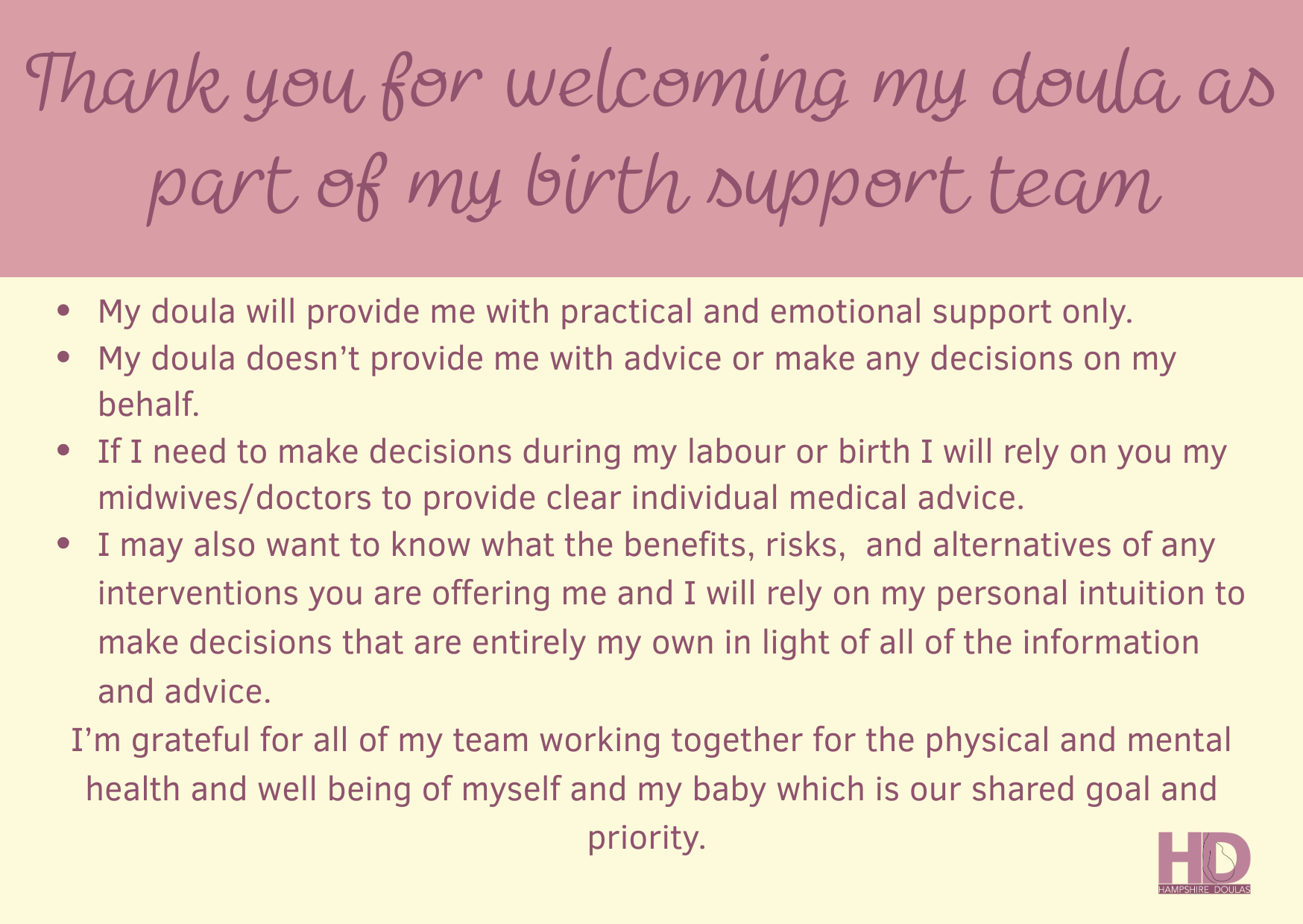
Tap the button below to download a PDF version to print

 Hampshire Doulas